Sessions end; context does not carry
The next session, yours, a teammate's, or another agent's, starts without the decisions, constraints, and validation results the last one produced.
 Day ShiftComparison
Day Shift vs chat history
Chat transcripts are the default record of coding-agent work, and they are a poor one: unstructured, unreviewable, and gone when the session ends. Day Shift moves the plan, the evidence, and the review record into repository files that outlast every session.
Where chat works
Where chat breaks down
The next session, yours, a teammate's, or another agent's, starts without the decisions, constraints, and validation results the last one produced.
A pull request built from chat gives reviewers diffs without intent. What was in scope? What was validated? What was deliberately deferred?
A plan stated in chat is a suggestion. Nothing checks that the implementation stayed inside it or that the promised validation actually ran.
Before and after
Inspect a local example
The current gate is task-close. The manifest has no stale or incomplete inputs, three historical command errors, and zero current validation failures. The task is closed; the lifecycle run itself has no terminal state.
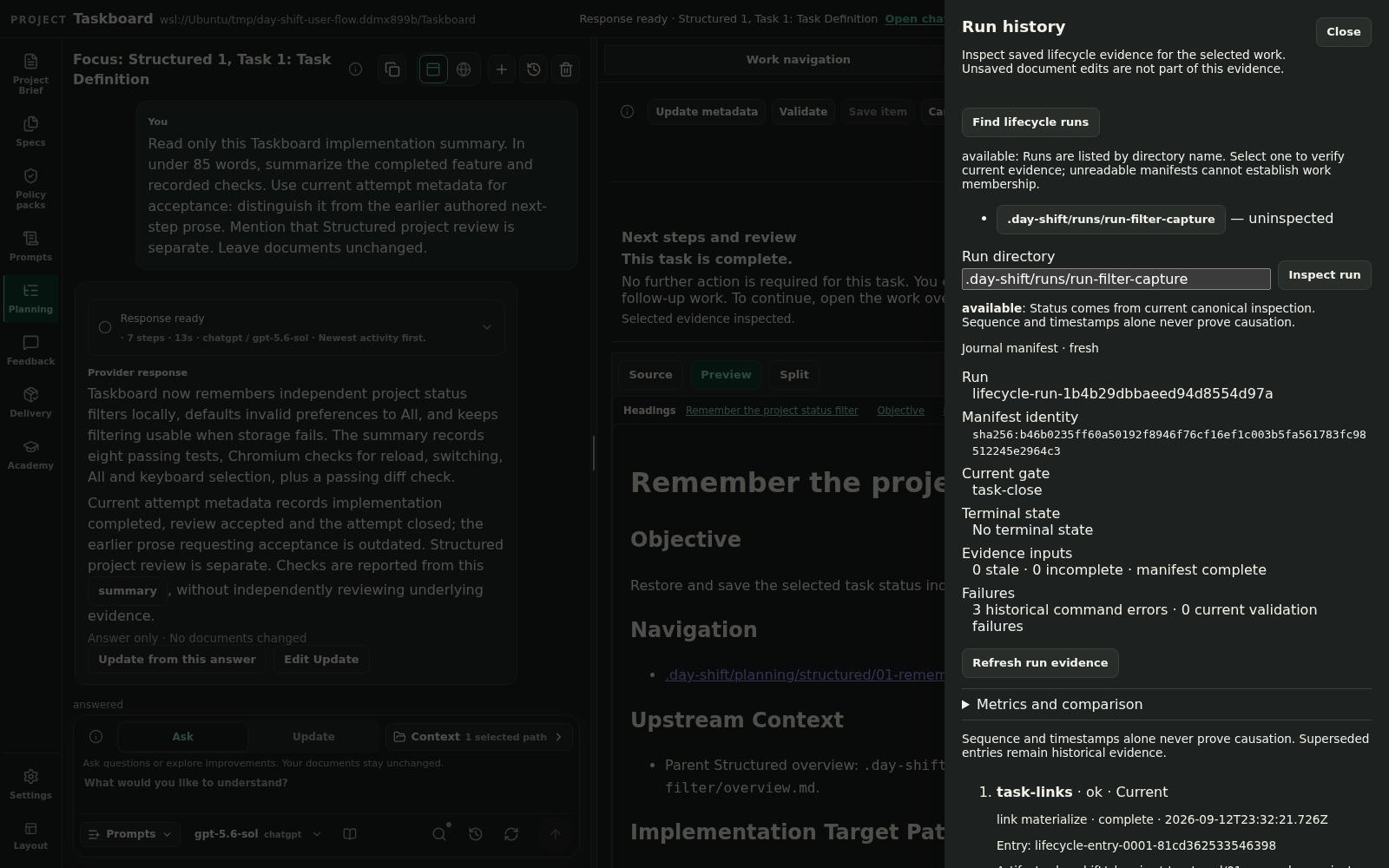
Earlier command errors remain in the saved evidence. Sequence and timestamps alone do not establish causation.
Taskboard example · September 12, 2026 · Day Shift development build.
Inspect the full-size screenshotStart small
Free to evaluate with no signup and no online activation. If the implementation summary and reconciliation record are not clearly better than the transcript, stop there.