Intent
What is being built, written as a spec the plan traces back to, not a prompt that disappears with the session.
 Day ShiftWork agreement and evidence
Concept
Day Shift is a local workspace for planning, guiding, and reviewing AI-assisted software work, with a browser GUI and CLI. These records give humans and coding agents a shared continuation point across sessions, tools, and contributors.
What belongs in the contract
What is being built, written as a spec the plan traces back to, not a prompt that disappears with the session.
Which files and behaviors a task is allowed to touch, declared before the agent writes code.
The required checks are named up front, and their executed, recorded, or imported results remain visible beside the work.
What actually changed and what actually passed, recorded in an implementation summary beside the code.
Read-only review findings stay separate from the explicit action that accepts, revises, blocks, cancels, or closes the work.
The category, after the concrete workflow
Day Shift records the work agreement and implementation evidence. Review is read-only; acceptance and closure are explicit actions.
Day Shift exposes collaboration policy to compatible agents but does not grant unlimited authority or force unsupported agents to comply.
The current Day Shift CLI can execute a task revision's complete declared validation set in order with `task validation-set`, execute one explicitly selected command with `task validation-record`, or import evidence produced elsewhere. Declared-set execution rejects arbitrary extra argv, records every command independently, and stops on the first required failure.
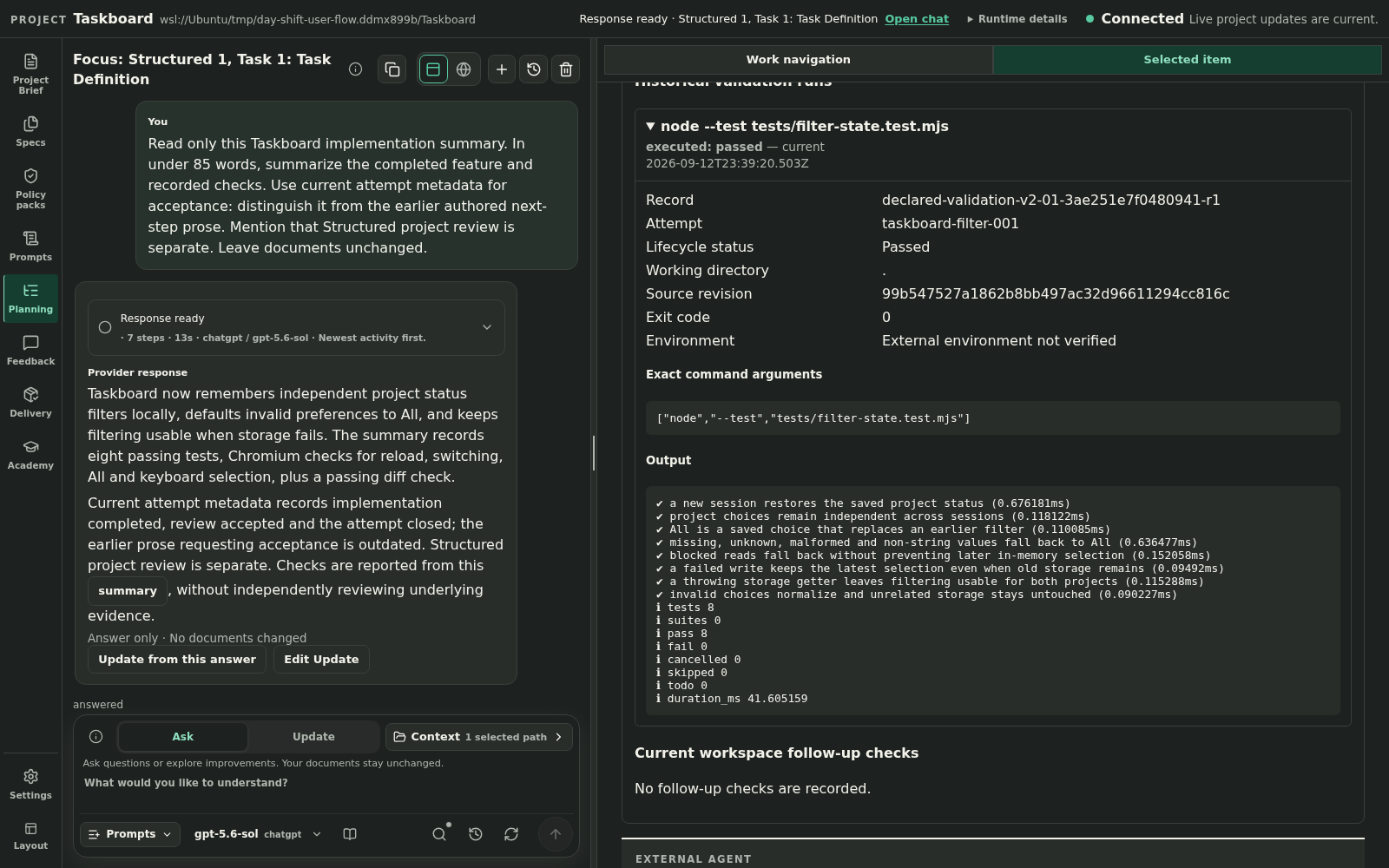
Taskboard’s completed attempt retains the executed command, exit code, and eight passing tests. The environment remains labeled unverified; these results describe local execution, not a CI run or deployment.
Taskboard example · September 12, 2026 · Day Shift development build.
Inspect the full-size screenshotDeterministic versus model-assisted
The CLI can check structure, traceability, and readiness without asking a model to infer those mechanical contracts.
Routine planning and summarization layers work with the models you already have access to.
Reserved for ambiguous product intent, architecture decisions, risky changes, and conflicting evidence.
Where Day Shift fits
Day Shift organizes and preserves agent-assisted engineering work. It does not replace the coding agent, Git, CI, issue tracking, or code review.
Created and maintained by Tianna McCoy. Published by TNSDS. Tianna develops Day Shift and maintains its repository workflow and product evidence.